Creative Diversity: The Competitive Advantage Most Meta Advertisers Still Ignore
If you’re still asking, “How many creatives should I test this week?” you’re asking the wrong question.
The better question is:
“How many different buying motivations am I giving Meta’s AI to learn from?”
Most advertisers think creative diversity means making ten versions of the same ad.
Different headline.
Different color.
Different CTA.
Different thumbnail.
That’s not creative diversity.
That’s creative duplication.
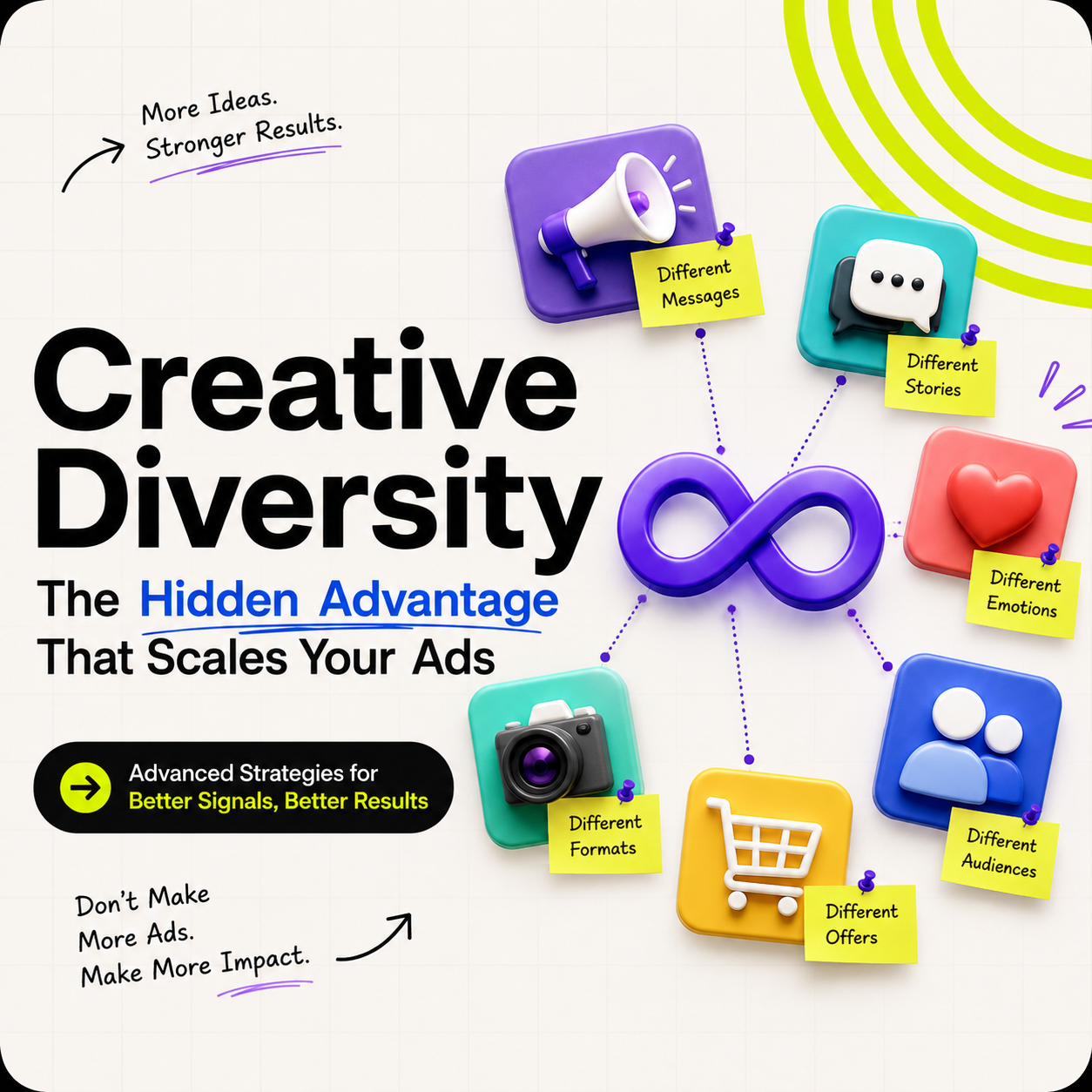
In the AI era of Meta advertising, creative diversity isn’t about producing more ads—it’s about producing more unique signals.
The brands that understand this are scaling while everyone else is wondering why their winning creative died after three weeks.
This article introduces a different way to think about creative diversity—one that focuses on psychology, data quality, and algorithmic learning instead of simply increasing creative volume.
The Creative Diversity Myth
Ask ten media buyers what creative diversity means, and you’ll hear answers like:
- More videos
- More images
- More headlines
- More UGC
- More hooks
Those things help.
But they don’t solve the real problem.
Meta doesn’t learn from the number of creatives.
It learns from the difference between them.
Imagine testing these five ads:
- “Premium Cotton Tee”
- “Luxury Cotton Tee”
- “Soft Premium Tee”
- “Best Cotton Shirt”
- “Premium Everyday Tee”
That’s five ads.
But it’s only one idea.
Now compare that with:
- The confidence angle
- The comfort angle
- The sustainability angle
- The value angle
- The craftsmanship angle
That’s also five ads.
But it’s five completely different learning opportunities.
One gives Meta five copies.
The other gives Meta five new customer profiles.
That difference changes everything.
The Signal Diversity Framework
Forget counting creatives.
Instead, measure Signal Diversity.
Every advertisement sends signals to Meta about:
- Who this message is for
- Why someone should care
- What emotional trigger it activates
- What type of buyer is likely to respond
The broader those signals become, the smarter Meta becomes.
Think of your creative library like a map.
Every unique concept expands the territory Meta can explore.
Every duplicate concept keeps it walking in circles.
The Four Layers of Creative Diversity
Most advertisers only diversify visuals.
Professional advertisers diversify four different layers simultaneously.
Layer 1 — Message Diversity
This is what you say.
Instead of repeating product features, rotate different messaging categories.
Examples:
Problem-focused
“We’re tired of replacing cheap basics.”
Identity-focused
“For people who care about how they present themselves.”
Transformation-focused
“Upgrade your wardrobe without changing your style.”
Lifestyle-focused
“Built for travel, work and weekends.”
Educational
“Why heavyweight cotton lasts longer.”
Authority
“What we’ve learned after helping hundreds of brands scale.”
Every message attracts different buyers.
Layer 2 — Emotional Diversity
Most brands accidentally market to only one emotion.
Instead, intentionally rotate emotional triggers.
Examples include:
Confidence
Security
Curiosity
Relief
Belonging
Status
Achievement
Freedom
Urgency
Comfort
Meta begins recognizing completely different behavioral patterns for each emotional cluster.
Layer 3 — Format Diversity
Creative isn’t just images versus videos.
Think broader.
Test:
Founder talking
Customer interview
Lifestyle montage
Problem-solution animation
Product teardown
Comparison chart
Behind-the-scenes
User-generated content
Carousel education
Minimal static
POV video
Interactive comments
Every format reaches people who consume content differently.
Layer 4 — Buying Stage Diversity
This is where most advertisers fail.
Every customer isn’t ready to buy today.
Some people are:
Problem Aware
Some are:
Solution Aware
Some are:
Product Aware
Some only need reassurance.
Create creative specifically for each stage.
Your account suddenly becomes far more resilient.
Stop Measuring Creative Fatigue
Instead, Measure Creative Coverage
Most advertisers ask:
“When should we replace this creative?”
A better question is:
“What customer groups aren’t we speaking to yet?”
Imagine your audience is divided into:
- Busy parents
- Young professionals
- Fitness enthusiasts
- Frequent travelers
- Minimalists
- Luxury buyers
- Budget-conscious shoppers
If all your creatives only speak to minimalists…
Your account isn’t fatigued.
It’s incomplete.
Creative diversity expands audience coverage naturally.
The Creative Matrix Method
Here’s a framework we’ve found useful for planning campaigns.
Don’t organize ads by format.
Organize them by psychology.
| Customer Emotion | Content Type | Offer | Stage |
|---|---|---|---|
| Confidence | Founder Video | Premium | Awareness |
| Comfort | Product Demo | Bundle | Consideration |
| Fear of Missing Out | UGC | Limited Edition | Decision |
| Status | Lifestyle | Premium | Purchase |
| Trust | Testimonial | Money-back Guarantee | Decision |
Now every new creative fills an intentional gap.
Instead of guessing what to produce next, the matrix shows you.
Why More Creatives Don’t Always Improve Performance
Many brands upload:
30 ads.
Performance barely changes.
Why?
Because they accidentally built:
30 versions…
of the same advertisement.
Quantity without diversity creates algorithm fatigue.
Quality diversity creates algorithm intelligence.
The Creative Entropy Score
Here’s a simple concept your team can adopt.
Rate every creative from 1–10.
Not by quality.
By uniqueness.
Ask:
Does this introduce:
A new customer?
A new emotion?
A new objection?
A new story?
A new visual language?
If the answer is mostly “No,” the entropy score is low.
Low entropy usually means limited learning.
High entropy means Meta receives richer behavioral data.
Build Creative Libraries Instead of Campaign Libraries
Most agencies organize work like this:
Campaign
↓
Ad Set
↓
Ads
Instead, organize your business like this:
Customer Problems
↓
Customer Desires
↓
Objections
↓
Stories
↓
Proof
↓
Offers
↓
Formats
Now every future campaign becomes faster to produce.
You’re building assets—not starting over every month.
The 70-20-10 Creative Model
Many advertisers either play it too safe or chase every trend.
A balanced system works better:
70% Proven Concepts
Your top-performing angles that consistently generate sales.
20% Optimized Variations
Improve winners with stronger visuals, better storytelling, or updated offers.
10% Experimental Ideas
Completely new concepts your competitors haven’t tested yet.
This balance keeps performance stable while allowing innovation.
Why AI Rewards Diversity
Meta’s AI doesn’t know your ideal customer.
It discovers them.
Every genuinely different creative helps narrow the search.
Imagine giving the algorithm one flashlight.
Now imagine giving it twenty.
That’s what creative diversity really does.
It expands the search space.
Not by increasing spend—
but by increasing learning.
Advanced Creative Workflow
Here’s a process many advertisers overlook:
Week 1 — Research
Collect customer reviews.
Support tickets.
Sales calls.
Reddit discussions.
Competitor comments.
Identify recurring language.
Week 2 — Theme Extraction
Instead of creating ads immediately, group insights into themes.
Examples:
Quality
Price
Confidence
Comfort
Trust
Convenience
Identity
Community
Week 3 — Concept Development
Each theme becomes multiple creative concepts.
One theme.
Five executions.
Week 4 — Production
Produce multiple formats for every concept.
Not because Meta likes volume—
because different people consume information differently.
Week 5 — Learning Review
Don’t simply ask:
“What won?”
Ask:
“What did Meta learn?”
Which emotions performed?
Which objections disappeared?
Which customer segment expanded?
That’s the insight worth keeping.
The Future of Creative Strategy
As Meta’s AI continues to improve, audience targeting will become even more automated.
Creative will become the primary competitive advantage.
Not prettier creative.
Not more expensive creative.
Smarter creative systems.
Brands that build structured, diverse creative ecosystems today will adapt to future algorithm changes far more easily than brands relying on one “winning ad.”
Final Thoughts
Creative diversity isn’t about flooding your ad account with endless variations.
It’s about giving Meta’s AI a richer understanding of your customers.
Every unique message, emotion, format, story, and buying stage adds another layer of intelligence to your campaigns.
The brands that scale consistently aren’t the ones creating the most content.
They’re the ones creating the widest range of meaningful signals.
In the next era of Meta advertising, your creative library won’t just be a collection of ads.
It will become your greatest competitive asset.
Key Takeaways
- Don’t measure the number of creatives—measure the diversity of ideas.
- Organize creatives around customer psychology, not ad formats.
- Test different emotions, stories, and buying stages instead of minor design changes.
- Build a repeatable creative system rather than chasing individual winning ads.
- Treat every new creative as a new learning signal for Meta’s AI—not just another advertisement.
The future belongs to advertisers who don’t just create more ads—they create more ways for the algorithm to understand their customers.